The lowest and highest prices of the same business-class ticket, observed within a single month, differ on average by more than half. This article describes where that variability comes from and illustrates it with a measurement on routes from Warsaw.
8 min read
Introduction
Business-class fares on long-haul routes are widely regarded as unpredictable. Two questions bring order to the subject: how large the price spread is for the same route and cabin, and which mechanisms produce it. The first part describes how prices are set in premium cabins; the second presents a measurement of offers collected between August and October 2026, mainly for departures from Warsaw.
The pricing mechanism: booking classes and demand forecasting
An airline does not sell seats; it sells places in booking classes. A booking class is a pool of seats in a given cabin, identified by a letter, sold at a set price and on set conditions. In the business cabin, the letters J and C usually denote full, flexible fares, while D, Z or I denote cheaper fares, bought in advance and hedged with restrictions. The number of seats in each class is set separately for every flight and changes over time.
Decisions to open and close classes are made by the revenue management department. It forecasts how many passengers willing to pay the full fare will come forward in the final weeks before departure, and holds seats back for them; the rest it sells earlier and more cheaply. Prices therefore rise in steps, at the moment the cheapest open class sells out, not continuously.
The structure of demand
The model was built around the business traveller, who books late, changes plans and does not pay out of pocket. This group's share of revenue is disproportionate to its size. According to IATA, in the first eight months of 2017 business- and first-class passengers made up 5.2 percent of passengers on international routes and accounted for 25.5 percent of revenue; over the North Atlantic that share reached about 47 percent, and between Europe and Asia about 37 percent. A premium passenger paid on average three to six times as much as an economy passenger.
Since the pandemic, the structure of demand has changed. CAPA analysts describe the growing importance of private travellers choosing business class on leisure routes, and judge that this may matter more to airline economics than the recovery of business travel. Demand segmentation, that is, separating passengers with different price sensitivity through fare conditions, now extends to the premium cabin as well.
Drivers of variability
Seasonality in the business cabin does not coincide with seasonality in economy, because the peak of private travel falls in periods when business travel slackens. The second factor is the connection: carriers with hubs in the Persian Gulf and Istanbul fill their aircraft with passengers from many markets at once and compete on price with direct services. The third is the point of sale: fares are published separately for each country of sale, and smaller markets, lacking corporate demand, receive lower fares. Hence the practice of starting a journey in another city to take advantage of its fares (a positioning flight).
Mistake fares and regulation
Some extremely low prices result from errors in publishing fares, for example an omitted fuel surcharge or a mistaken exchange rate. On 8 May 2015 the US Department of Transportation announced that it would not enforce the requirement to honour mistaken fares, provided the carrier demonstrates the error and reimburses the passenger's costs. The same agency requires that a reservation for a flight to or from the United States, made at least seven days before departure, can be cancelled free of charge within 24 hours; this also applies to non-US carriers. The European Union has no uniform rule on mistake fares.
Measurement: data from routes out of Poland
The dataset comprises 784 business-class offers on routes of at least 3,000 km, collected between 23 August and 26 October 2026, departing from Warsaw, Berlin or Wrocław to 88 cities. For each offer, a typical price range for the route and dates was available, together with a price rating: low, typical or high.
The median price was 2,640 EUR, with an interquartile range of 1,980 to 3,027 EUR. The typical price range itself is wide: its upper bound was on average 29 percent above its lower bound (median ratio 1.29; interquartile range 1.20 to 1.47; n = 784). In first class the ratio was 1.61 (n = 695). For the same route and month, a price a quarter above the lowest should therefore be regarded as ordinary.
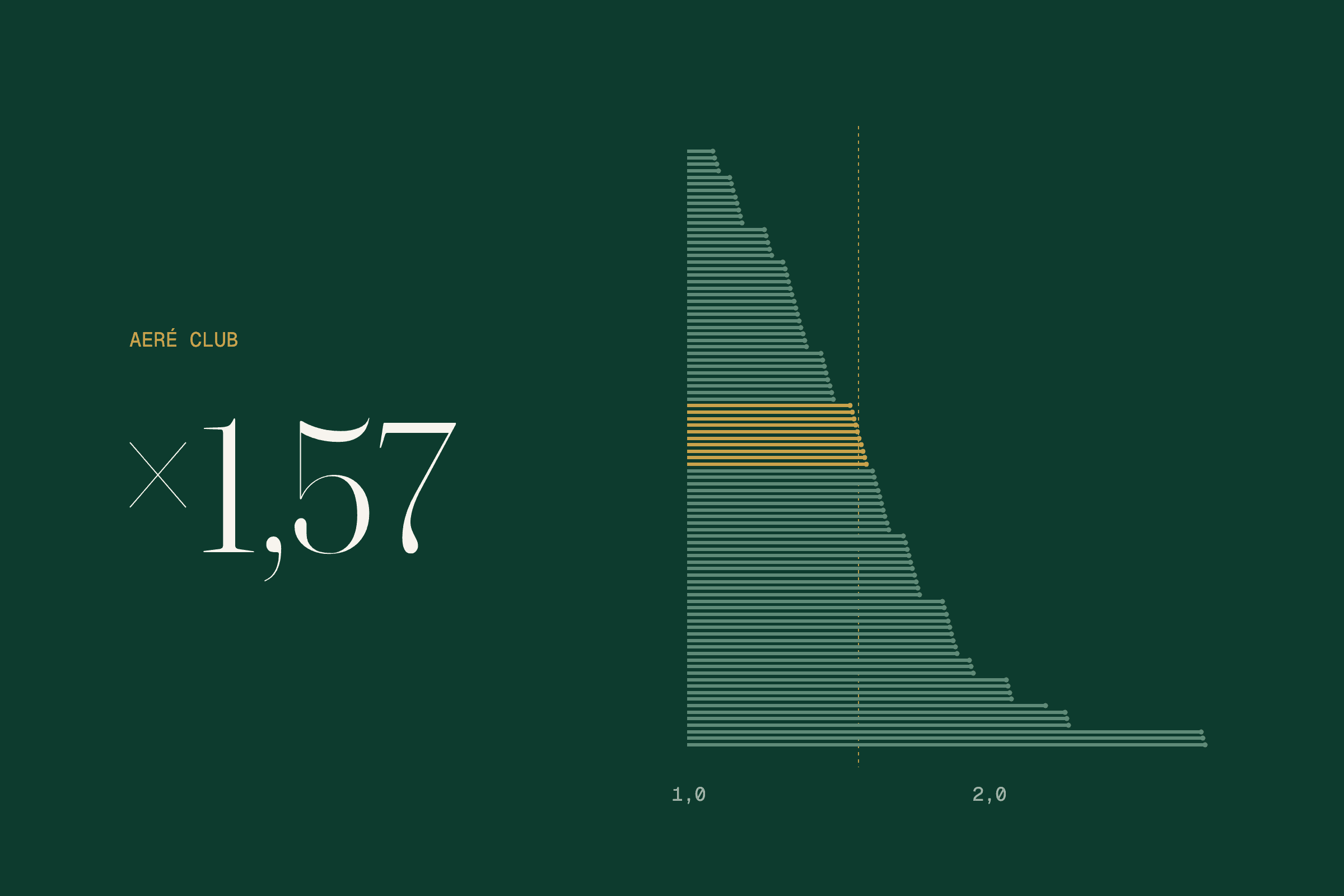
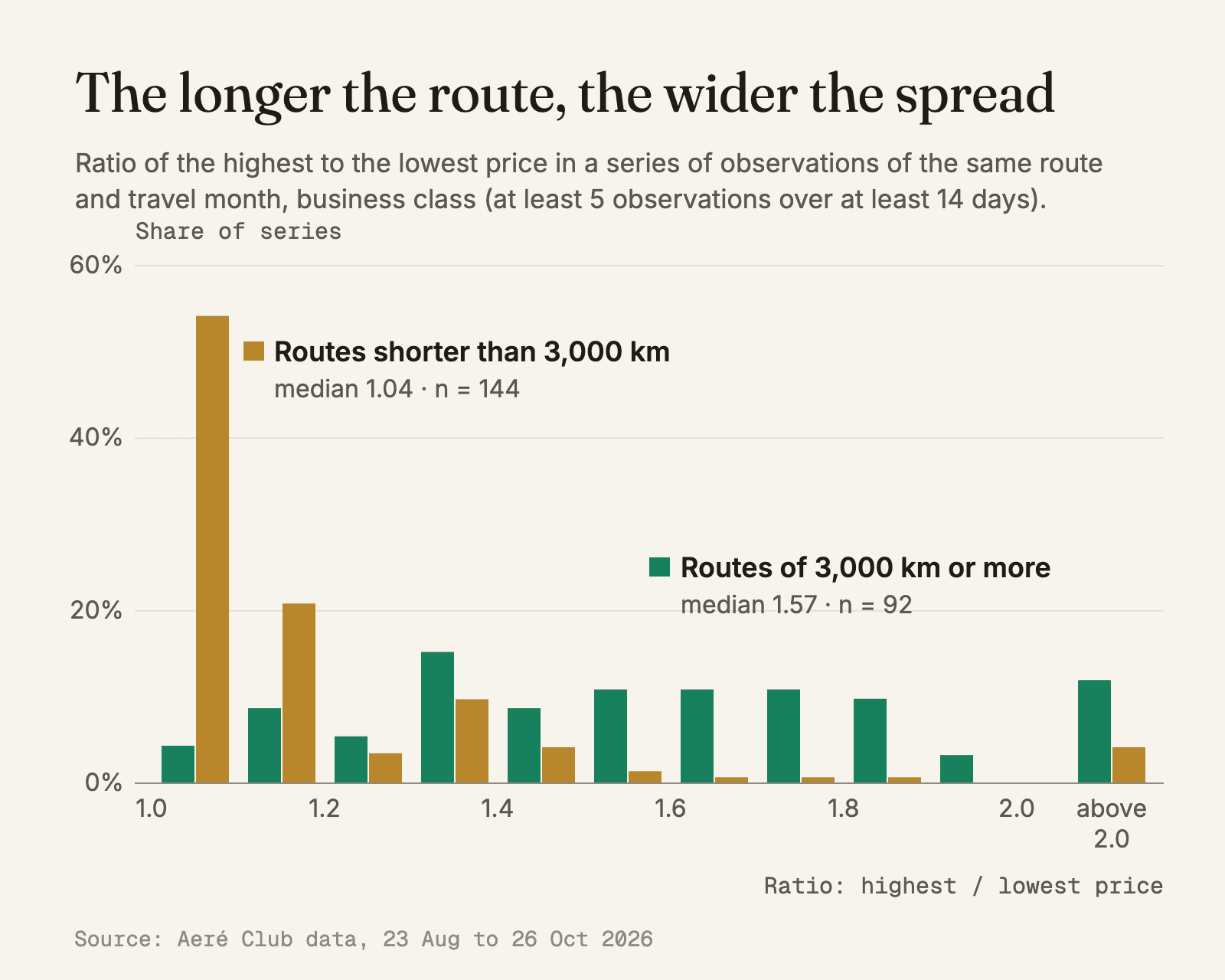
Variability over time was measured on observation series: for 92 route and travel-month pairs, each observed at least five times over a period of at least 14 days (on average 9 observations over 25 days), the median ratio of the highest price to the lowest was 1.57 (interquartile range 1.35 to 1.80). In 58 percent of series the highest price exceeded the lowest by at least half, and in 12 percent by at least a factor of two. For routes shorter than 3,000 km the median was 1.04 (n = 144); variability therefore increases with route length.
Offers labelled low price made up 45 percent of the sample, typical 47, high 8. These shares do not describe the market as a whole, because the sample is not random. What is informative is the size of the discount: a low price lay at the median 5.6 percent below the lower bound of the typical range (interquartile range 2.7 to 13.0 percent; n = 356), and only 11 percent of such offers were cheaper by 20 percent or more. In first class the median was 13.0 percent (n = 401). A high price meant at the median 11.6 percent above the upper bound (n = 60).
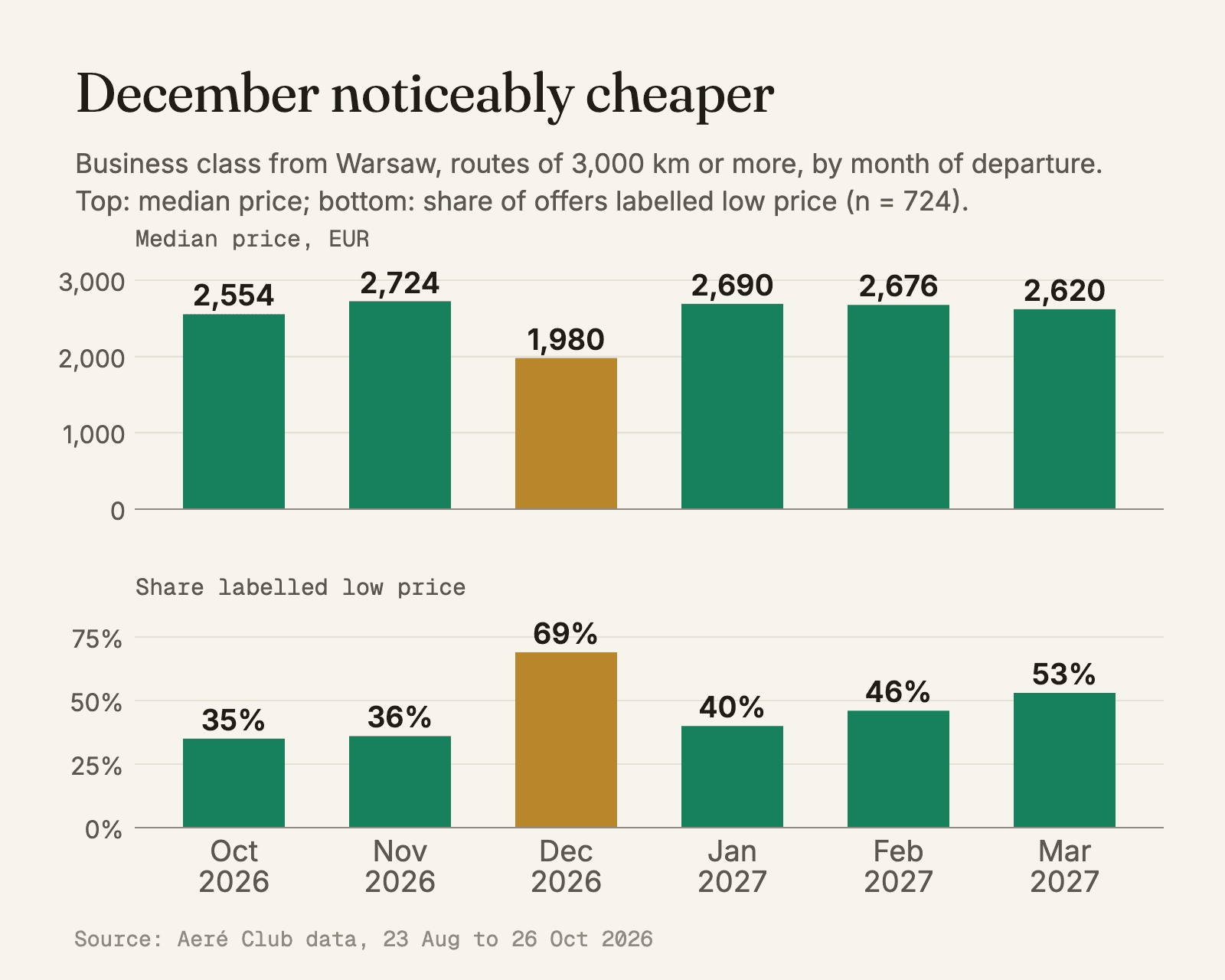
Seasonality by month of departure from Warsaw:
| Departure month | n | Median price (EUR) | Share labelled low price | Price to lower bound of typical range (median) |
|---|---|---|---|---|
| October 2026 | 74 | 2,554 | 35% | 1.06 |
| November 2026 | 166 | 2,724 | 36% | 1.14 |
| December 2026 | 140 | 1,980 | 69% | 0.97 |
| January 2027 | 166 | 2,690 | 40% | 1.05 |
| February 2027 | 118 | 2,676 | 46% | 1.07 |
| March 2027 | 60 | 2,620 | 53% | 1.05 |
December was the only month in which the median price lay below the lower bound of the typical range. An explanation consistent with the mechanism described above is the absence of business demand over the holiday period, but the sample covers one season and one departure city, so the result needs confirming over a longer series.
The median price to Asia and Oceania was 2,086 EUR (n = 397), and to the Americas 2,892 EUR (n = 319); 98 percent of offers had at least one connection.
The durability of offers was measured on 35 deals that have already expired (22 in business class, 13 in first). None lasted longer than seven days; in business class, 73 percent closed within 48 hours. The measurement has a resolution of roughly one day, and the sample is small; the result indicates only that cheap fares disappear on a scale of days, not weeks.
Methodology
The data cover publicly available round-trip fares, in euros, collected between 23 August and 26 October 2026. The sample is not random: departures are overwhelmingly from Warsaw, and the period covers a single season. Distances were calculated as the great-circle distance between cities. The median and interquartile range are given instead of the mean, because price distributions are skewed.
Conclusions
Price spread in business class is a feature of the booking-class system, not an anomaly. For the same route and month, the typical price range is around 30 percent wide, and the lowest price observed within a month differs from the highest by more than half on average. Discounts labelled low price are usually moderate, from a few percent to the teens below the lower bound of the range; larger ones require a coincidence of circumstances: a weak month, a connection or a fare error. Cheap fares last on a scale of days. The data come from Aeré Club's observations.
Sources
- IATA Economics, Where does premium-class demand matter the most?, 10 November 2017.
- CAPA Centre for Aviation, The premium leisure paradox: Europe's high-value passengers rewrite airline economics.
- US Department of Transportation, Mistaken Fare Policy Statement, 8 May 2015.
- US Department of Transportation, Notice on the 24-hour reservation requirement.
- The Points Guy, Airline fare classes; AwardFares, Airline Booking Class Codes Explained.
- Simple Flying, Why positioning fares are quietly becoming the smartest way to book premium cabins.